
Overview of Pharmaceutical Equipment
What Is Pharmaceutical Manufacturing Equipment
Pharmaceutical manufacturing equipment supports the controlled filling, packing, sealing, and finishing of medicines. A practical pharmaceutical equipment list includes machinery for solid doses, liquids, semi-solids, and unit-dose products.
Nuestro pharmaceutical packaging and filling systems serve applications such as tablets, capsules, pharmaceutical liquids, creams, sachets, pouches, vials, tubes, and plastic ampoules. Equipment can be configured for precise product handling from primary pack to final transport packaging.
| Equipment Area | Typical Pharmaceutical Use |
|---|---|
| Blister packing machines | Tablets and capsules |
| Plastic ampoule FFS machines | Unit-dose pharmaceutical liquids and serums |
| Vial filling monoblocks | Liquid filling and stoppering |
| Capsule filling machines | Hard capsule processing |
| Tube filling and sealing machines | Creams and ointments |
| VFFS, HFFS, and premade pouch systems | Powders, granules, liquids, and sachets |
| Cartoning and overwrapping machines | Secondary retail packaging |
| Case packers and palletizers | End-of-line packing and stacking |
Key Features of Compliant Pharma Machinery
Compliant pharma machinery must combine hygienic design, repeatable dosing, reliable controls, and packaging security. Our systems are designed around these operating requirements, with modular construction to support faster cleaning, efficient changeovers, and flexible line integration.
Key capabilities include:
- 99.5% dosing and filling precision
- Weighing tolerance below 0.5%
- CIP/SIP-compatible hygiene protocols for suitable filling applications
- HMI controls, load cell measurement, and positive displacement pumps
- Tamper-evident sealing for product protection
- Modular layouts for bag-size changes and maintenance access
- Flexible formats for sachets, pouches, vials, tubes, blister packs, and cartons
For high-output requirements, standard packaging speeds range from de 30 a 80 bolsas por minuto. Horizontal form fill seal systems can reach 75 bolsas por minuto, while flow wrapping machinery can operate at up to 200 paquetes por minuto for applicable products.
Importance of GMP Compliance in Pharma Equipment
GMP compliance helps pharmaceutical manufacturers maintain controlled processes, product consistency, and hygienic packaging conditions. Equipment selection should align with the applicable requirements for GMP, FDA, WHO, and ISO 9001 standards.
A well-designed pharmaceutical equipment list should prioritize:
- Cleanable product-contact areas
- Accurate and repeatable filling performance
- Secure seals and protected finished packs
- Controlled operation through dependable machine interfaces
- Support for Factory Acceptance Testing, commissioning, and validation planning
- Reliable spare parts and long-term technical service
Our pharmaceutical packaging machinery is engineered for global buyers seeking compliance-focused performance, with turnkey in-house design, sample testing, FAT support, and lifetime after-sales service.
API and Chemical Processing Equipment List
API and chemical processing equipment prepares pharmaceutical materials before filling and packaging. Our verified equipment range is focused on pharmaceutical filling, packing, and end-of-line systems, so reactor, filtration, drying, milling, and sifting specifications should be confirmed with the relevant process-equipment supplier.
Industrial Chemical Reactors
Industrial chemical reactors are used in upstream processing where controlled chemical reactions are required. A jacketed reactor may support heating or cooling during processing, depending on the formulation and production method. For pharmaceutical projects, reactor selection must align with cleanability, material compatibility, and applicable GMP requirements.
Filtration and Separation Equipment
Filtration and separation equipment helps remove unwanted particles or separate materials during pharmaceutical processing. The right configuration depends on the product’s physical properties, batch size, and required process controls. Downstream filling equipment should be matched to the final liquid, viscous, powder, or corrosive product characteristics.
Industrial Drying Machinery
Industrial drying machinery reduces moisture in processed materials before later handling or packaging. Equipment such as a fluid bed dryer or spray dryer may be used in specific production environments, but the selected system must suit the material and validation requirements. Stable product condition supports more consistent dosing and packaging performance.
Milling and Sifting Equipment
Milling and sifting equipment is used to manage particle size and improve material consistency. Uniform powders and granules can support accurate handling in pharmaceutical packaging operations, including sachet, pouch, and capsule applications. For dosing-focused equipment, our systems provide up to 99.5% filling precision with a weighing tolerance below 0.5%.
Solid Dosage Manufacturing Equipment
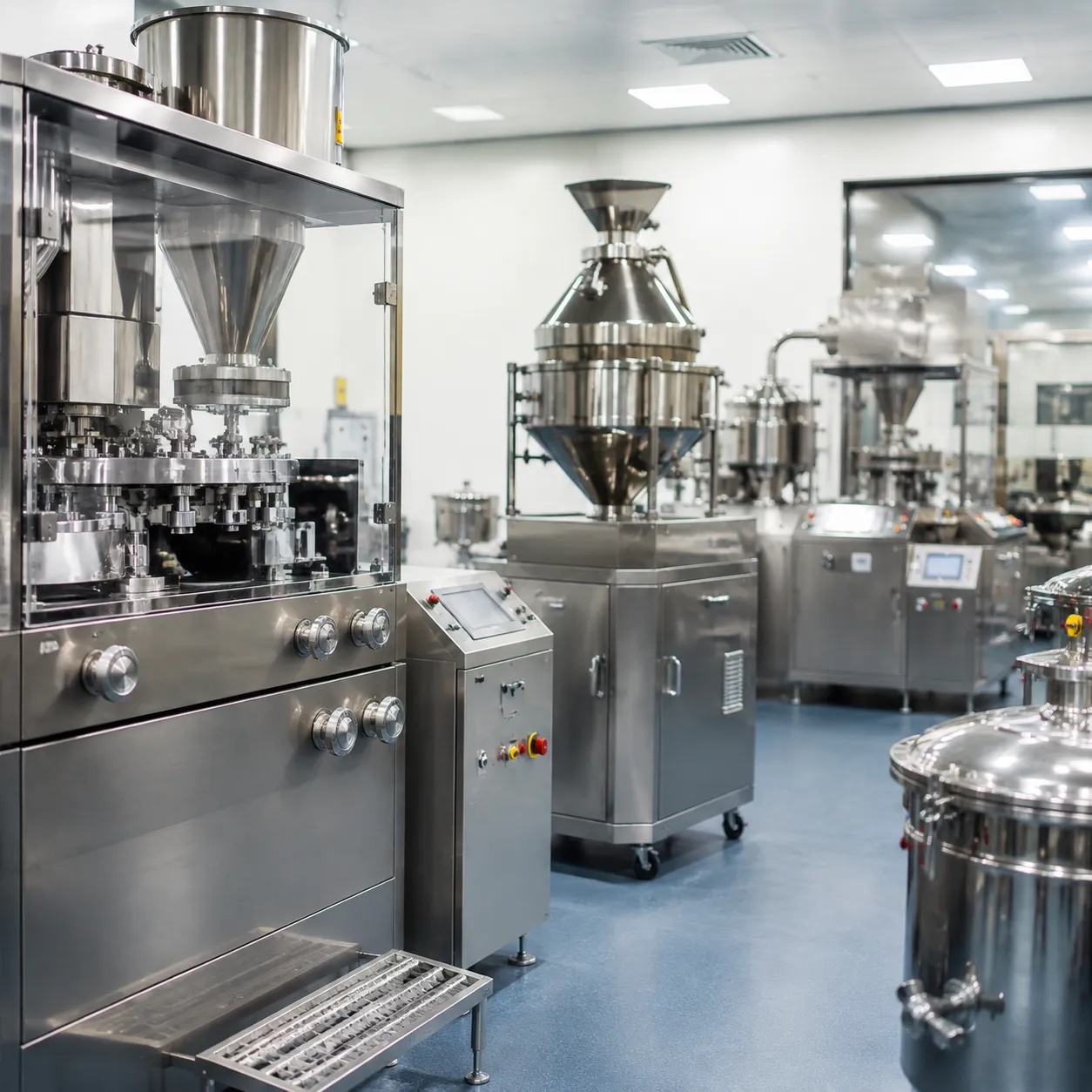
A solid dosage pharmaceutical equipment list may include systems for preparing, dosing, filling, and finishing tablets and capsules. We support pharmaceutical projects with capsule filling, blister packing, flexible sachet packing, cartoning, labeling, and end-of-line machinery designed around GMP, FDA, WHO, and ISO 9001 requirements.
Granulation and Mixing Equipment
Granulation and blending equipment prepare powder materials before they enter a capsule filler or other solid-dose process. For a complete line, we review product characteristics, required output, hygiene controls, and the connection between upstream preparation equipment and the final filling or packaging system.
Tablet Compression Machines
Tablet compression machines, commonly called tablet presses, form powder blends into tablets at controlled weights and shapes. Equipment selection should consider production rate, changeover needs, dust control, and quality control requirements. Our guide to types of tablet press machines outlines common tablet press configurations used in pharmaceutical production.
Capsule Filling Machinery
Nuestro capsule filling machinery is designed for hard capsule processing in pharmaceutical operations. Accurate dosing is central to product consistency, and our filling solutions are supported by HMI controls, load-cell measurement, and modular machine design where applicable. We also provide line engineering to connect capsule processing with reliable downstream packing formats.
Tablet Coating Systems
Tablet coating systems apply functional or protective finishes to tablets before final presentation. When building a full pharmaceutical line, coating equipment should align with cleaning procedures, batch requirements, and the selected packaging machinery. Our in-house design and layout review services help create practical equipment connections for compliant, efficient operation.
Liquid and Semi-Solid Processing Equipment

Liquid and semi-solid products need controlled, hygienic handling from preparation through filling. Within a pharmaceutical equipment list, this category covers equipment for liquid products, viscous formulations, creams, ointments, and similar applications. Our filling systems are designed around precise dosing, clean operation, and compatibility with GMP, FDA, WHO, and ISO 9001 requirements.
Liquid Mixing and Storage Tanks
Liquid processing commonly requires mixing and holding equipment before the filling stage. Storage tanks should support consistent product handling, practical cleaning, and reliable transfer to downstream equipment.
For pharmaceutical liquid filling, we provide inline and weighing filling machines that handle liquid, viscous, powder, and corrosive products. Key system features can include:
- HMI controls for clear operation
- Load cell measurement for controlled filling
- Positive displacement pumps for liquid and viscous products
- CIP/SIP protocols to support hygienic production requirements
- Modular layouts for easier cleaning and line integration
For corrosive liquid applications, materials matter. Our approach to piston fillers for acidic liquids using 316L stainless steel supports durable, dependable filling where product compatibility is essential.
Homogenizers and Emulsifiers
Homogenizing and emulsifying steps help create a stable, consistent liquid or semi-solid product before it reaches the packaging machine. While processing requirements vary by formulation, the filling stage must maintain the same focus on accuracy and cleanability.
Our pharmaceutical filling equipment supports controlled dosing with 99.5% filling precision and a weighing tolerance below 0.5%. This level of control is valuable for products that require repeatable fill volumes across vials, tubes, ampoules, sachets, and pouches. Modular construction also supports faster cleaning and practical format adjustments when production needs change.
Ointment and Cream Manufacturing Systems
Ointments, creams, gels, and other semi-solid products require filling equipment that can manage thicker formulations without compromising dosing consistency. Our máquinas de llenado y sellado de tubos are suited to tube packaging applications, while piston filling systems and other specialized fillers support viscous product formats.
Relevant options within our pharmaceutical equipment list include:
- Tube filling and sealing machines for cream and ointment tubes
- Llenadoras de pistón for viscous and specialized liquid products
- Vial filling monoblocks for pharmaceutical liquid filling and stoppering
- máquinas de formado, llenado y sellado de ampollas de plástico for unit-dose liquid products
- Spout pouch fillers for flexible-packaging applications
Built for global pharmaceutical operations, these systems combine precision filling, hygienic design, and flexible packaging formats. Our in-house engineering team can support layout review, sample testing, Factory Acceptance Testing, commissioning, spare parts supply, and lifetime after-sales service.
Pharmaceutical Packaging Equipment List
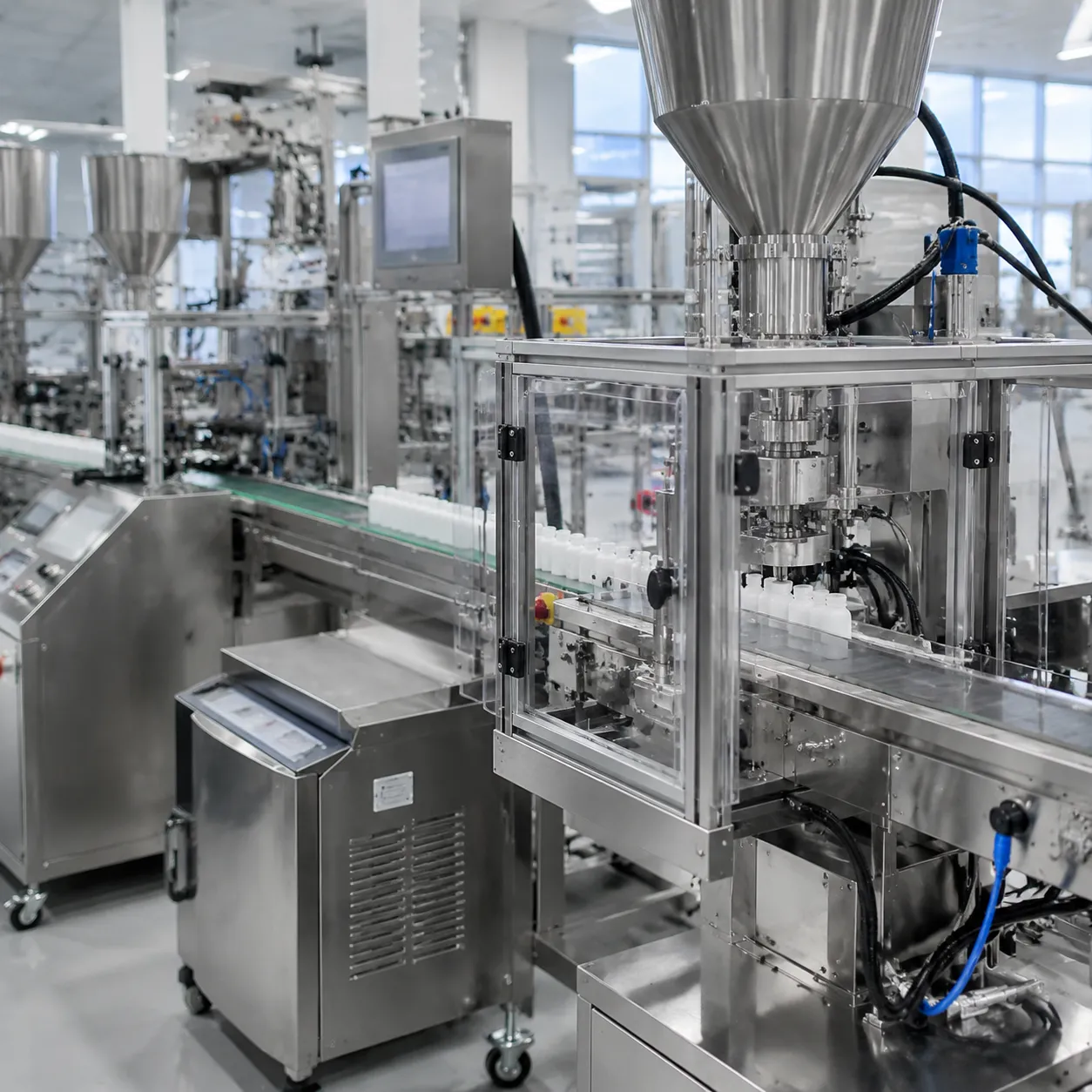
Our pharmaceutical equipment list covers primary packs, secondary packs, and finishing systems that support accurate dosing, hygienic handling, secure sealing, and efficient line output. We build equipment to meet GMP, FDA, WHO, and ISO 9001 requirements, with modular layouts that suit both growing pharmaceutical businesses and established global production sites.
Primary Packaging Equipment
Primary packaging machinery protects the medicine at the point of contact. Our systems support tablets, capsules, powders, granules, liquids, creams, ointments, and unit-dose products.
- Blister packing machines for tablets, capsules, consumer products, and electronics
- máquinas de formado, llenado y sellado de ampollas de plástico for unit-dose pharmaceutical liquids and aseptic filling applications
- Vial filling and stoppering monoblocks for pharmaceutical liquid filling
- Capsule filling machines for hard capsule processing
- Tube filling and sealing machines for pharmaceutical creams and ointments
- máquinas VFFS for powders, granules, and liquids in sachets, pouches, and multilane packs
- Máquinas HFFS for four-side-seal packs and other solid, semi-solid, or irregular products
- Máquinas de envasado de bolsas premontadas for powders, liquids, granules, and sauces, with up to 70% vacuum effect
For solid-dose lines, our blister packaging guide and its key advantages explains why blister formats remain a practical option for product visibility and protected retail presentation. Filling systems can integrate HMI controls, load cell measurement, and positive displacement pumps where appropriate, helping achieve 99.5% filling precision and weighing tolerance below 0.5%.
Secondary Packaging Equipment
Secondary pharmaceutical packaging equipment prepares primary-packed products for distribution, retail display, and transport. We supply integrated machinery including cartoning systems, empacadoras de cajas, y palletizadoras that that reduces manual handling and keeps end-of-line movement organized.
- Máquinas encartonadoras for automatic carton forming and product loading, including sachet cartoning
- Overwrapping and cellophane wrapping machines for protective retail box film wrapping
- Encajonadoras for grouping and loading finished cartons or packs into shipping cases
- Paletizadores for automated stacking at the end of the packaging line
Our packaging machinery can be configured as part of a turnkey line, supported by in-house design, layout review, Factory Acceptance Testing, commissioning, and spare parts supply. Modular construction also supports quicker pack-size changeovers, simpler cleaning, and reliable line operation.
Labeling and Serialization Systems
Clear, consistent identification is essential for pharmaceutical packaging. Our labeling equipment applies labels to bottles, containers, and packaged products across different line formats.
- Rotary servo capping machines
- 8-wheel linear cappers
- Round bottle labeling machines
- Double-side labeling machines
- Sleeve labeling machines
- Glue labeling machines
These systems support an orderly finished-pack process alongside tamper-evident sealing technology. For international pharmaceutical operations, the focus remains on dependable application, clean presentation, and alignment with GMP, FDA, WHO, and ISO 9001 standards.
Pharmaceutical Laboratory and QC Equipment

Analytical Laboratory Instruments
Analytical laboratory instruments are not specified within our pharmaceutical equipment range. For line-level quality control, our filling and packaging systems use HMI controls, load cell measurement, and positive displacement pumps to support consistent dosing. Verified performance targets include 99.5% filling precision and a weighing tolerance below 0.5%.
Physical Testing Equipment
Physical testing supports packaging quality by confirming accurate fills, secure seals, and reliable pack handling. Our pharmaceutical packaging machinery incorporates tamper-evident sealing and supports formats including blister packs, sachets, pouches, ampoules, vials, and tubes. Packaging material performance can also be affected by surface friction, as explained in this guide to the coefficient of friction in packaging.
Microbiology Laboratory Equipment
Microbiology laboratory equipment is not listed as part of our manufacturing range. However, hygiene is built into applicable pharmaceutical filling solutions through CIP/SIP clean-in-place and sterilization-in-place protocols. This supports clean processing requirements for unit-dose liquids, serums, pharmaceutical liquids, and other sensitive applications under GMP, FDA, WHO, and ISO 9001 standards.
How to Choose the Right Pharmaceutical Equipment
La adecuada pharmaceutical equipment list should match product type, output targets, cleanroom needs, and regulatory requirements. We build packaging and filling solutions around practical line performance, reliable dosing, and efficient long-term operation.
Production Capacity and Scalability Requirements
Start with the required pack format, fill volume, and production rate. A line should meet current demand without making routine changeovers difficult.
| Selection Area | Qué revisar |
|---|---|
| Product format | Tablets, capsules, powders, liquids, creams, or unit-dose products |
| Packaging type | Blisters, vials, tubes, sachets, pouches, cartons, or cases |
| Objetivo de producción | Standard systems can operate at 30–80 bags per minute; flow wrapping can reach up to 200 ppm |
| Changeovers | Modular construction supports faster bag-size changes and cleaning |
| Line growth | Select equipment that can connect with capping, labeling, cartoning, case packing, and palletizing |
For flexible unit-dose applications, the choice between sachets and stick packs affects material use, presentation, and machine configuration. Our guide to choosing the right sachet packing machine explains the key format considerations.
Compliance and Regulatory Standards
Pharmaceutical machinery must support controlled, repeatable, and hygienic production. We supply equipment designed to meet GMP, FDA, OMS y ISO 9001 de requisitos.
Key compliance-focused features include:
- 99.5% dosing and filling precision
- Weighing tolerance below 0.5%
- CIP/SIP-ready hygiene protocols for applicable filling systems
- Tamper-evident sealing options
- HMI controls, load cell measurement, and positive displacement pumps where required
- Cleanable machine layouts and rapid format changeovers
For production areas exposed to washdown, dust, or moisture, selecting the right enclosure rating also helps protect equipment and support stable operation. See our practical guide on choosing an IP rating for a production environment.
Equipment Validation and Maintenance Protocols
Validation and maintenance should be planned before installation, not after production begins. Confirm that the equipment can support factory acceptance testing, commissioning, documented performance checks, and routine servicing.
| Requisito | Practical Focus |
|---|---|
| Pruebas de Aceptación de Fábrica | Verify machine operation before shipment |
| Commissioning | Confirm installation and performance at the production site |
| Accuracy checks | Monitor fill weights, seals, and packaging consistency |
| Cleaning procedures | Use accessible, hygienic designs that reduce downtime |
| Repuestos | Maintain essential replacement parts for continuous operation |
| After-sales support | Use responsive technical support throughout the machine life cycle |
Our in-house engineering, layout review, sample testing, FAT support, commissioning, spare parts supply, and lifetime after-sales service help keep pharmaceutical packaging lines operating with confidence.